

The United Kingdom’s Solicitors Regulation Authority (the “SRA”), which regulates solicitors and law firms in England and Wales, released its Anti-Money Laundering (“AML”) Annual Report this past fall. The report summarized the SRA’s AML supervisory work from April 2024 to April 2025 and detailed how the SRA monitors firms, enforces the Money Laundering Regulations 2017, and contributes to the UK’s wider economic crime framework.
Why the Focus on Money Laundering?
The SRA estimates that over £100 billion is laundered through the UK each year, while the UK’s National Crime Agency estimates that there are 4,500 organized crime groups operating in the country. Additionally, the UK Home Office’s annual risk assessment has classified the legal sector as high risk with respect to money laundering and terrorist financing, just behind the
banking/financial services and real estate sectors. It is against this backdrop that the SRA has significantly intensified its AML supervision and uncovered material weaknesses in some law firms’ risk assessments, governance, and due diligence processes.
As an American lawyer, the fact that the SRA actively engages with law firms on the subject of AML compliance initially surprised me, as US-based law firms do not have a national regulatory body that undertakes similar activities. Over the past few months, I’ve noticed a substantial number of AML compliance positions being advertised by law firms in the UK. At first, I was puzzled. These types of roles are commonly posted by financial services firms, but generally not by law firms (at least in the US!). A Google search quickly solved this mystery by revealing that several UK-based firms got slapped with hefty AML compliance fines during 2025…
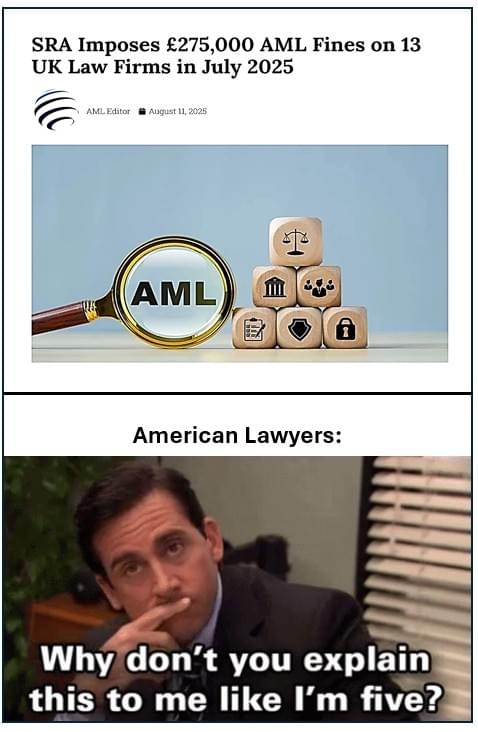
I cannot recall any time period during which a string of US-based law firms got fined for compliance failures, so the SRA’s actions piqued my interest. Now, upon reviewing the SRA’s report summarizing a blockbuster year of enforcement activity, I would like to highlight a few figures that stood out:
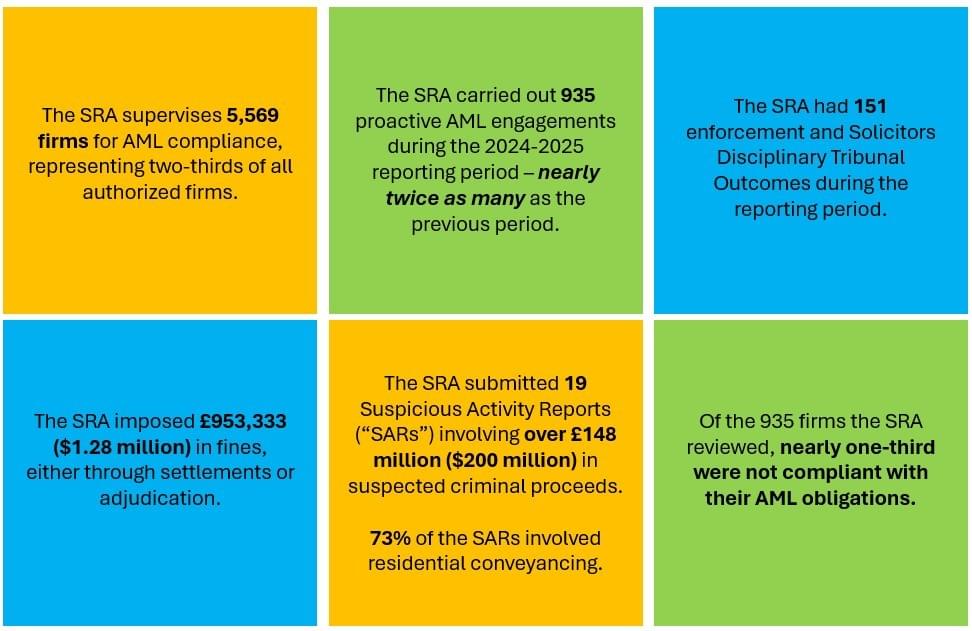
One-Third Not Compliant?!
One of the most shocking elements of the SRA’s annual report was the revelation that one-third of law firms failed to comply with their AML obligations. In addition to the one-third of firms that received a “Not compliant” grade, 54% of firms the SRA reviewed received a “Partially compliant” score – meaning only 13% of firms received a “Compliant” rating. These statistics are pretty
surprising, given the fact that we’re talking about law firms receiving these grades. Fortunately, the SRA also detailed some common pitfalls:
- 50% of non-compliant firms were referred due to missing or ineffective client/matter risk assessments.
- In 111 of those firms there was a process in place, but it was not being followed. This shows a disconnect between the policies, controls and procedures, and what is happening at matter level.
- 41% of firms received feedback on source of funds/wealth controls – a key gatekeeping measure.
The SRA also helpfully listed key themes that it believes contributed to the compliance breaches:
- Inadequate importance, at senior levels within firms, placed on having robust and compliant AML controls in place. For example, adequately risk assessing the firm’s exposure to money laundering and terrorist financing or putting adequate policies, controls and procedures (PCPs) in place.
- Inadequate supervision or training of fee earners on the regulations and thereafter the firm’s PCPs.
- Having systems and processes that allow events to happen unchecked, such as receipt of funds or moving to the next stage in the transaction (rather than an automated ‘stop’ being put to a transaction when an element of customer due diligence has not been performed).
What Happens Next
The SRA report’s foreword notes that the Financial Conduct Authority (the “FCA”) is set to become the single professional services supervisor for anti-money laundering going forward. There is currently no firm date for when the SRA will transfer its AML responsibilities to the FCA, and the
SRA’s report explained that this change “is still subject to the passage of enabling legislation, confirmation of funding arrangements, and development of a detailed transition and delivery plan.” The UK’s AML supervision regime has been somewhat fragmented, with one publication counting 22 professional body supervisors responsible for AML supervision with respect to various sectors. Consolidating AML enforcement into a single enforcement agency should centralize oversight and promote consistency. In terms of enforcement powers, fines for inadequate AML compliance could be much greater under the FCA than under the SRA. The SRA’s
largest AML fine was £300,000 during the time period covered by its latest report. In contrast, the FCA’s smallest fine during the same period was £289,000 (and its largest fine was £39.3 million). Viewed through this lens, the frenzied job openings from UK law firms seeking money laundering specialists make a lot more sense.
There could also be at least one exogenous event that would motivate FCA and the UK government to complete this transition as quickly as possible: the Paris-based Financial Action Task Force (“FATF,” a global money laundering watchdog) is scheduled to conduct its next UK assessment in August 2027. The FATF’s 2018 report recommended the UK strengthen oversight of the legal and accounting sectors. Could the looming 2027 review motivate the UK authorities to move faster? Or is the review relatively inconsequential to the transition timeline? Only time will tell.